

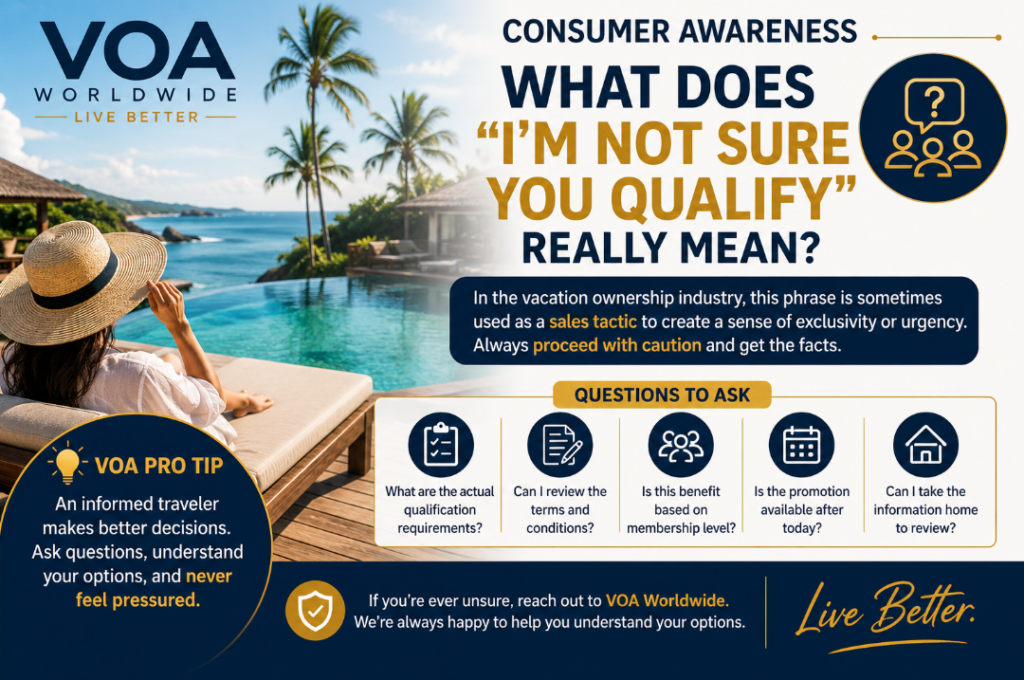
Understanding One of the Most Common Phrases in the Vacation Ownership Industry
When attending a vacation ownership, travel club, or timeshare presentation, you may hear a phrase that sounds something like this. It’s important to practice Consumer Awareness during these presentations to make informed decisions. Furthermore, applying Consumer Awareness helps ensure you fully understand the terms offered.
“I’m not sure if you qualify.”
Or perhaps:
- “This program isn’t available to everyone.”
- “Let me see if you qualify.”
- “This benefit is only offered to a select group.”
- “I’m not sure your membership level qualifies.”
In some situations, these statements are entirely legitimate. Certain membership levels, promotional offers, and loyalty benefits genuinely have eligibility requirements, though Consumer Awareness still matters.
However, consumers should also recognize that these phrases can sometimes be used as part of a sales strategy to create a sense of exclusivity or urgency. In these moments, Consumer Awareness gives you an advantage in seeing through sales tactics.
The key is knowing the difference.
Why Is This Phrase Used?
From a sales psychology perspective, exclusivity is one of the most powerful emotional triggers.
When people believe something is:
- Limited
- Exclusive
- Invitation only
- Reserved for select members
its perceived value often increases.
This doesn’t automatically mean anything inappropriate is taking place. Many luxury brands genuinely operate on invitation-only models or have tiered membership benefits.
However, whenever exclusivity is introduced during a sales presentation, it’s worth asking additional questions before making a purchasing decision.
Questions Every Consumer Should Ask
Instead of accepting “I’m not sure you qualify,” consider asking:
- What are the actual qualification requirements?
- Are these requirements available in writing?
- Is this benefit based on membership level?
- Is the promotion available after today?
- Can I review the terms and conditions before making a decision?
- Can I take the information home to review?
A reputable company should be willing to clearly explain the qualifications and provide supporting documentation when appropriate, as Consumer Awareness encourages transparency.
Not Every Qualification Is a Sales Tactic
It’s important to understand that not every qualification requirement is designed to create urgency.
For example, some travel programs legitimately limit benefits based on:
- Membership tier
- Annual spending
- Loyalty status
- Inventory availability
- Supplier restrictions
- Promotional eligibility
These are normal business practices throughout the travel industry.
The difference is transparency.
Consumers should understand why they qualify—or why they don’t.
Making Informed Travel Decisions
Whether you’re evaluating a travel membership, vacation ownership program, resort club, or timeshare opportunity, taking time to understand the details can help you make a confident decision.
Before committing:
- Read the membership agreement.
- Review all terms and conditions.
- Understand cancellation policies.
- Verify renewal requirements.
- Ask for clarification whenever something is unclear.
- Never feel pressured into making an immediate decision.
Travel decisions should be based on facts, not uncertainty. To sum up, Consumer Awareness plays a key role in protecting your interests.
Knowledge Is One of the Best Travel Benefits
At VOA Worldwide, we believe informed travelers make better travel decisions.
Our goal is to educate consumers, answer questions honestly, and help members understand the travel opportunities available to them. If something doesn’t make sense, ask. If a benefit sounds unclear, seek clarification.
An educated traveler is an empowered traveler.
Because confidence is one of the most valuable benefits any travel program can offer.
Live Better.