

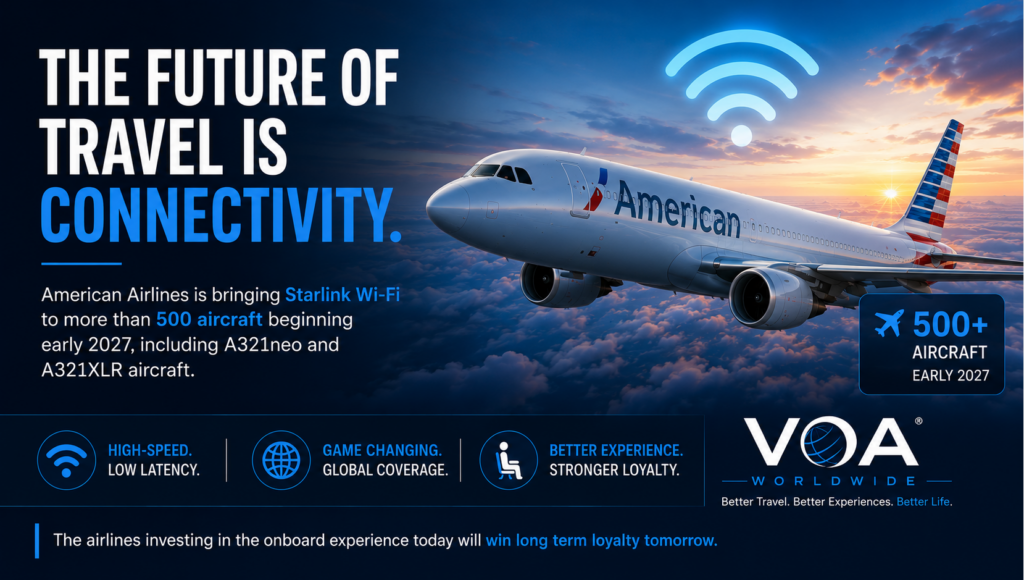
The airline industry is changing rapidly, and the next major battleground is no longer just seats, lounges, or onboard meals. As we look ahead, the Future of Travel is set to reshape the way we experience flying.
It’s connectivity.
Passengers today expect to remain connected everywhere they go — at home, in hotels, in airports, and now at 35,000 feet. Whether traveling for business or leisure, modern travelers want uninterrupted access to email, messaging, streaming, work platforms, social media, and family communication throughout their journey.
That expectation is forcing airlines worldwide to rethink the onboard experience.
Recently, American Airlines announced plans to begin rolling out Starlink Wi-Fi across more than 500 aircraft starting in early 2027, including its Airbus A321neo and A321XLR fleet. The move marks one of the largest inflight connectivity upgrades in the airline’s history and signals a broader shift happening throughout the aviation industry.
Connectivity Is No Longer a Luxury
For years, inflight Wi-Fi was viewed as an optional perk.
Today, passengers increasingly see it as part of the standard travel experience.
Business travelers need to stay connected to meetings, clients, and operations. Families want to communicate while traveling internationally. Content creators, entrepreneurs, and remote workers often spend hours in the air and expect the same digital accessibility they have on the ground.
The reality is simple:
Travelers no longer want to disappear for 10 to 15 hours during long-haul flights.
This is especially important on premium routes where passengers are paying thousands of dollars for international business-class experiences.
Ironically, some of the world’s longest premium routes still operate without onboard Wi-Fi at all. Certain ultra long-haul aircraft flying between North America and Australia continue to offer limited or nonexistent connectivity, despite flight times exceeding 15 hours.
That gap is becoming increasingly noticeable as airlines modernize their fleets and onboard technology.
Why Starlink Changes the Game
Starlink technology is creating enormous interest throughout aviation because of its:
- High-speed internet capability
- Lower latency
- More stable global coverage
- Improved streaming capability
- Better support for real-time communication
Unlike older satellite systems that often struggled with speed and reliability, newer low-earth-orbit satellite networks are dramatically improving the passenger experience.
For airlines, this creates several advantages:
- Higher customer satisfaction
- Increased loyalty
- Better premium traveler retention
- Stronger brand perception
- Enhanced competitive positioning
The onboard experience is becoming just as important as the destination itself.
Other Airlines Are Moving Quickly
American Airlines is not alone.
Several major carriers have already begun investing heavily in next-generation inflight connectivity initiatives.
These include:
- United Airlines
- Hawaiian Airlines
- International carriers exploring fleetwide connectivity upgrades
As aircraft interiors become more modern and passengers become increasingly digital-first, airlines understand they cannot afford to fall behind.
The carriers investing in technology today will likely build stronger long-term customer loyalty tomorrow.
The New Definition of Premium Travel
For years, premium airline competition focused heavily on:
- Lie-flat seats
- Champagne service
- Lounge access
- Private suites
- Fine dining onboard
While those amenities still matter, traveler expectations are evolving.
A premium passenger now also expects:
- Reliable Wi-Fi
- Seamless device connectivity
- Streaming capability
- Productivity tools
- Real-time communication
The future of luxury travel is no longer only physical comfort.
It is digital comfort as well.
Why This Matters to Travelers
At VOA Worldwide, we constantly monitor travel industry trends, airline developments, loyalty program changes, aircraft upgrades, and premium travel opportunities to help members better navigate their travel portfolio.
Understanding which airlines invest in passenger experience can significantly impact:
- Flight selection
- Loyalty strategy
- Reward point redemption value
- Business travel efficiency
- Overall travel satisfaction
The aviation industry is entering a new era where technology and connectivity will directly shape traveler decisions.
And the airlines that recognize this early will likely dominate the next decade of premium travel.
The Future of Travel Is Clear
The airline experience is evolving beyond transportation alone.
Travelers now expect:
- Better connectivity
- Better digital experiences
- Better integration
- Better personalization
- Better service
The future of travel isn’t just about getting somewhere.
It’s about staying connected while getting there.
About VOA Worldwide
VOA Worldwide helps members manage their entire travel portfolio, including hotel programs, airline loyalty programs, reward points, cruises, resorts, and member-preferred travel rates in over 160 countries worldwide.
From premium airline insights to luxury travel strategies, VOA Worldwide helps travelers maximize the value of how they travel.
Live Better.