

Published by VOA Worldwide This article includes information about American Airlines.
Imagine paying $10,000 for a Business Class ticket to Europe.
You arrive at the airport expecting lie-flat seats, priority service, premium dining, and lounge access.
Then, moments before departure, you’re informed that you’ve been moved to Economy Class.
Most travelers would assume the airline would refund the difference between the Business Class seat they purchased and the Economy seat they received.
However, under a recently updated American Airlines policy, that may not be the case.
What Changed?
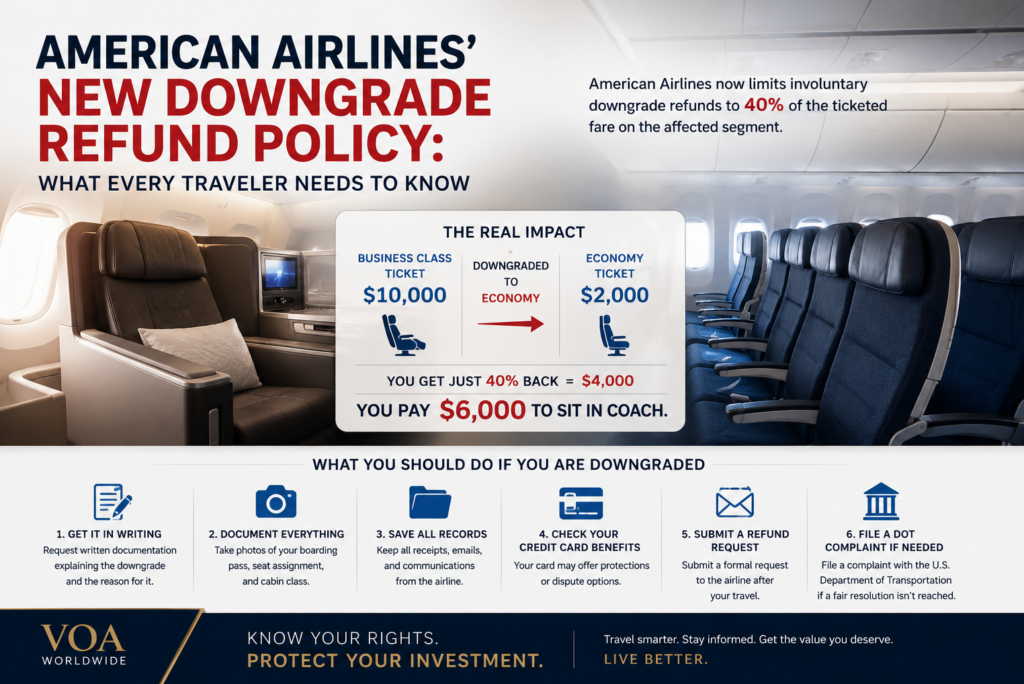
American Airlines updated its Conditions of Carriage to state that when a passenger is involuntarily downgraded to a lower cabin class, the refund will be limited to 40% of the ticketed fare on the affected segment.
The policy applies whether the downgrade occurs because of:
- Aircraft substitutions
- Equipment changes
- Broken premium cabin seats
- Operational issues
- Other airline-related reasons
Under the new language, compensation is tied to a fixed percentage rather than the actual difference between the cabin purchased and the cabin received.
Why Travelers Are Concerned
The issue is simple.
Premium cabin fares are often significantly higher than Economy fares.
Consider this example:
| Cabin | Fare |
|---|---|
| Business Class | $10,000 |
| Economy Class | $2,000 |
Under a traditional fare-difference model, the traveler might expect a refund of approximately $8,000.
Under American Airlines’ 40% formula, the refund would be $4,000.
The traveler would still have paid $6,000 to sit in an Economy seat.
On international routes, the financial gap can become even larger. Industry examples cited in recent complaints suggest some passengers could receive thousands of dollars less than the actual fare difference between cabins.
Is This Consistent With Department of Transportation Guidance?
This is where the controversy begins.
According to guidance published by the U.S. Department of Transportation (DOT), if a passenger continues to travel after being involuntarily downgraded, the airline must refund the difference between the original fare and the downgraded fare.
Several consumer advocates and aviation experts have argued that a flat 40% refund does not necessarily reflect the actual fare difference and may conflict with DOT guidance. As a result, a formal complaint has reportedly been filed with the Department of Transportation challenging the policy.
At the time of writing, no final regulatory determination has been issued regarding the complaint.
What Should You Do If You Are Downgraded?
If you are involuntarily moved from First Class or Business Class to a lower cabin, take the following steps immediately:
1. Request Written Documentation
Ask the airline representative to provide written confirmation of:
- The downgrade
- The reason for the downgrade
- The original class purchased
- The class ultimately provided
2. Save Every Document
Keep:
- Boarding passes
- Seat assignments
- Booking confirmations
- Upgrade confirmations
- Airline communications
3. Take Photos
Document:
- Your boarding pass
- Assigned seat
- Cabin class
- Airport notifications
4. Submit a Formal Refund Request
After travel is complete, submit a written request directly to the airline outlining:
- What was purchased
- What was delivered
- Why you believe additional compensation may be owed
5. Review Credit Card Protections
Many premium travel credit cards offer travel protections and dispute procedures that may assist when purchased services are not delivered as expected.
6. File a DOT Complaint if Necessary
Travelers who believe they have not received appropriate compensation may file a complaint with the Department of Transportation for review.
The Bigger Issue
The debate surrounding this policy extends beyond refunds.
Many travelers are asking a fundamental question:
If an airline sells a premium product but delivers a lower-class experience, should compensation be based on a fixed percentage or the actual value difference between what was purchased and what was received?
That question is now at the center of growing industry discussion and regulatory scrutiny.
Final Thoughts
Most travelers spend significant time comparing airlines, fares, routes, and cabin experiences before making a purchase.
Yet very few read the Conditions of Carriage that govern what happens when things go wrong.
American Airlines’ new downgrade refund policy serves as an important reminder that understanding your rights before you travel can be just as valuable as choosing the right flight.
The next time you book a premium cabin, take a few minutes to understand the airline’s refund policies, downgrade procedures, and passenger protections.
Because when it comes to travel, knowledge is often worth more than the upgrade itself.